
Amazon Warehousing and Distribution (AWD) is one of Amazon's most powerful inventory management tools, yet it is also one of the most misunderstood.
Many sellers hear about AWD and assume it's simply a cheaper version of FBA. Others believe it replaces FBA entirely. Some rush to implement it too early, while others ignore it when it could significantly reduce costs and improve inventory management.
The reality is that AWD can be an outstanding program when implemented at the right stage of growth—but it is not designed for every seller or every product.
Understanding what AWD is, what it isn't, and when it makes sense can help sellers avoid costly mistakes while creating a more scalable inventory strategy.
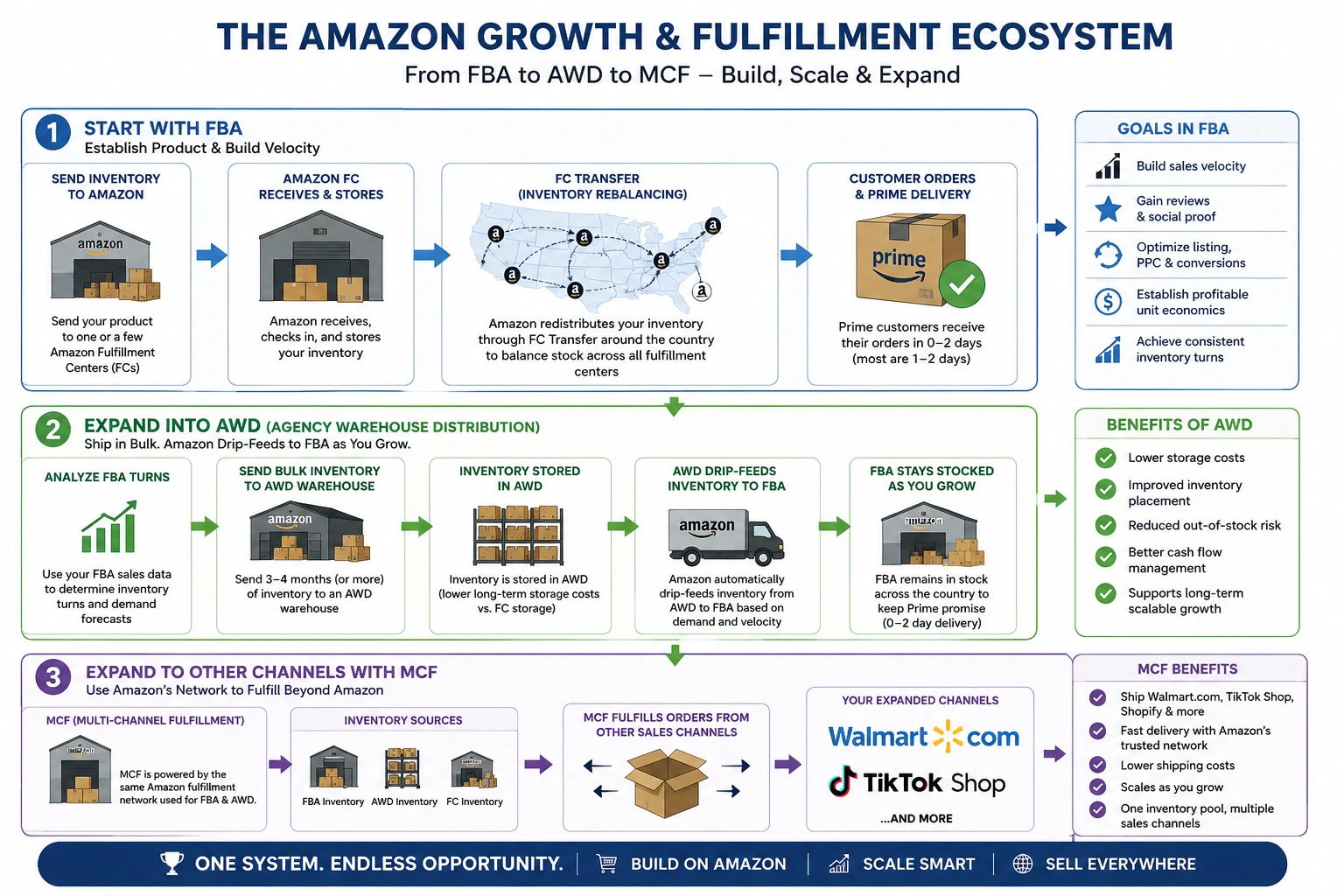
What Is Amazon AWD?
Amazon Warehousing and Distribution (AWD) is Amazon's bulk storage and replenishment network.
Think of AWD as a strategic inventory reserve that sits behind your FBA inventory.
Rather than sending all of your inventory directly into FBA fulfillment centers, you send larger quantities into AWD. Amazon then monitors your FBA inventory levels and automatically replenishes FBA inventory based on sales velocity and demand forecasts.
The result is a system where:
- AWD stores larger quantities of inventory.
- FBA stores customer-ready inventory.
- Amazon automatically replenishes FBA as needed.
This creates a more efficient inventory flow and often lowers overall storage costs.
What AWD Is Not
One of the biggest misconceptions is that AWD replaces FBA.
It does not.
AWD does not ship customer orders directly.
FBA remains the customer-facing fulfillment network responsible for Prime delivery and order fulfillment.
Think of the relationship this way:
AWD = Inventory Storage and Replenishment
FBA = Customer Fulfillment and Prime Delivery
AWD supports FBA.
It does not replace it.
If FBA is the retail shelf, AWD is the warehouse behind the store.
Why AWD Works Best After Proof of Concept
One of the biggest mistakes sellers make is implementing AWD before they've proven product demand.
AWD works best when you already know:
- The product sells consistently.
- Advertising is working.
- Inventory turns are predictable.
- Demand forecasts are reasonably accurate.
- You have confidence in reorder quantities.
In other words, AWD works best after you've established proof of concept through FBA.
At DMM, we generally recommend the following progression:
Phase 1: FBA
Launch the product.
Build reviews.
Optimize listings.
Refine PPC campaigns.
Establish profitability.
Phase 2: FBA Scaling
Develop predictable sales velocity.
Improve forecasting accuracy.
Understand inventory turns.
Build confidence in replenishment quantities.
Phase 3: AWD
Once demand becomes more predictable, AWD becomes a logical next step for reducing costs and improving inventory management.
Skipping directly to AWD before understanding demand can create unnecessary inventory risk.
How Amazon Determines Replenishment Quantities
One of the most valuable aspects of AWD is Amazon's ability to automatically replenish FBA inventory.
Amazon analyzes factors such as:
- Historical sales velocity
- Seasonal trends
- Inventory levels
- Forecasted demand
- Regional purchasing patterns
- Prime delivery requirements
Based on these factors, Amazon moves inventory from AWD into FBA fulfillment centers before inventory shortages occur.
The goal is to keep products in stock while maintaining Prime delivery standards.
This automation reduces the manual forecasting burden on sellers and often improves inventory placement throughout Amazon's fulfillment network.
Common AWD Mistakes
Implementing Too Early
Many sellers attempt AWD before they have reliable sales data.
Without predictable demand, forecasting becomes difficult and inventory can remain idle longer than expected.
Sending Too Much Inventory
Just because AWD can store large quantities does not mean sellers should send excessive inventory.
Products with uncertain demand should still be managed carefully.
Ignoring Cash Flow
Inventory stored in AWD still represents invested capital.
Sellers should balance inventory availability with cash flow requirements.
Not Monitoring Inventory Health
AWD is not a "set it and forget it" program.
Inventory levels, demand trends, and replenishment performance should still be monitored regularly.
Using AWD for Every Product
Some products simply are not good AWD candidates.
Slow-moving products may not benefit enough from AWD's replenishment advantages to justify bulk storage.
Inventory Age Matters
One consideration many sellers overlook is inventory age.
Although AWD can reduce storage costs compared to keeping large quantities directly inside FBA, inventory is still aging while it sits in AWD.
This is especially important for:
- Supplements
- Food products
- Cosmetics
- Health products
- Products with expiration dates
- Seasonal inventory
For products with limited shelf life, sellers should carefully balance inventory quantities with expected sales velocity.
Sending a year's worth of inventory into AWD may create unnecessary risk if demand slows unexpectedly.
The best AWD candidates are products with healthy sales velocity and sufficient shelf life to support longer-term storage.
When AWD Saves Money
AWD can generate significant savings when:
- Sales are predictable.
- Inventory turns are healthy.
- Products are replenished regularly.
- Sellers maintain larger inventory positions.
- Long-term growth is planned.
Potential benefits include:
- Lower storage costs
- Reduced stockout risk
- Improved inventory placement
- Automated replenishment
- Better scalability
- Reduced operational complexity
For growing brands, AWD can become an important part of a more sophisticated inventory strategy.
When AWD May Not Save Money
AWD is not always the right answer.
It may provide limited benefits when:
- Products have highly unpredictable demand.
- Sales volume remains low.
- Inventory turns are slow.
- Products have short shelf lives.
- Cash flow is constrained.
In these situations, sellers may benefit more from maintaining tighter inventory levels within FBA until demand becomes more predictable.
The Ideal Progression: FBA → AWD → MCF
The most successful Amazon brands often follow a natural progression.
Start with FBA
Prove demand.
Build reviews.
Optimize advertising.
Establish profitability.
Expand into AWD
Lower storage costs.
Improve replenishment.
Scale inventory more efficiently.
Leverage MCF
Once AWD and FBA are operating smoothly, sellers can use Amazon's Multi-Channel Fulfillment (MCF) network to support:
- Walmart Marketplace
- TikTok Shop
- Shopify
- Direct-to-consumer websites
This creates a single inventory ecosystem capable of supporting multiple sales channels.
Final Thoughts
Amazon AWD is not a replacement for FBA. It is an extension of FBA.
Its purpose is to help sellers store inventory more efficiently, improve replenishment, reduce stockout risk, and support long-term growth.
For sellers who have already established product-market fit and predictable sales velocity, AWD can be a valuable tool that simplifies inventory management and creates meaningful cost savings.
The key is timing.
First prove the product through FBA.
Then scale through AWD.
Finally leverage MCF to expand beyond Amazon while operating from a single inventory pool.
That progression creates a far stronger foundation than attempting to scale everything at once.