
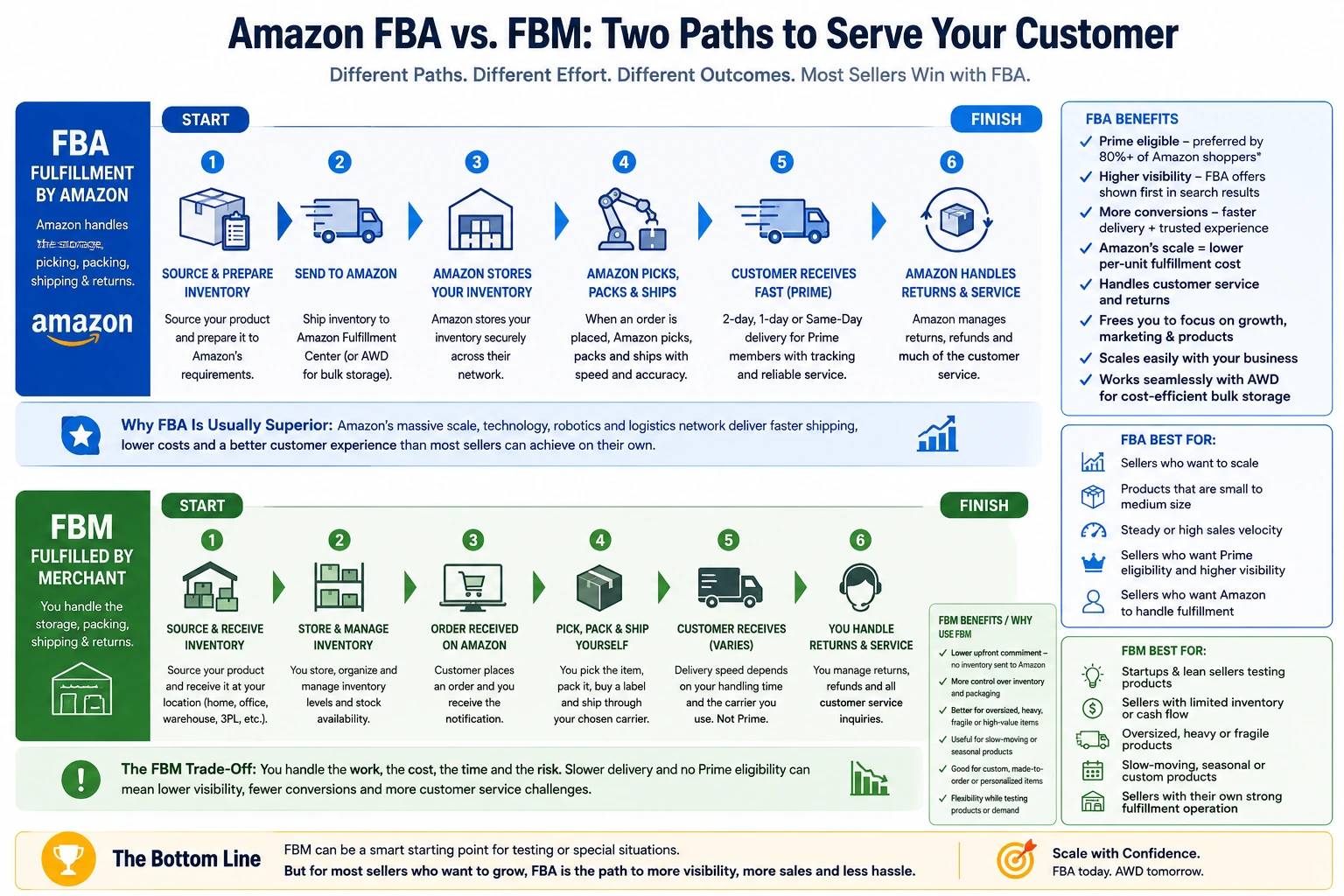
Amazon FBA vs. FBM: Which Fulfillment Method Makes More Sense for Sellers?
One of the most important decisions an Amazon seller makes is how orders will be fulfilled. On the surface, the choice looks simple: either Amazon ships the product through Fulfillment by Amazon, commonly called FBA, or the seller ships the product themselves through Fulfilled by Merchant, commonly called FBM.
But the real decision is not just about shipping. It is about cost, speed, customer expectations, ranking potential, operational complexity, and long-term scalability.
For most sellers, FBA is the stronger model. FBM has its place, especially for lean startups, oversized products, fragile items, custom orders, or businesses that already have strong warehouse operations. But when the goal is to compete seriously on Amazon, FBA usually gives sellers the better path.
What Is FBA?
Fulfillment by Amazon means the seller sends inventory into Amazon’s fulfillment network. Amazon stores the product, picks it, packs it, ships it to the customer, handles much of the delivery experience, and processes customer returns.
The seller still owns the product and controls the listing, pricing, advertising, and inventory planning. But the fulfillment operation is handled by Amazon.
That matters because Amazon is not just a marketplace. It is one of the most advanced logistics companies in the world.
What Is FBM?
Fulfilled by Merchant means the seller lists products on Amazon but handles fulfillment outside of Amazon’s FBA network. The seller may ship from their own warehouse, a garage, a small storage facility, a retail store, or a third-party logistics provider.
With FBM, the seller controls the inventory and shipping process directly. That can be useful in certain situations. But it also means the seller is responsible for storage, labor, packaging, shipping rates, delivery speed, tracking, customer expectations, and returns.
That is a lot to manage.
The Big Difference: Amazon’s Scale Is Hard to Beat
The biggest argument for FBA is not just convenience. It is scale.
Amazon can store, pick, pack, and ship products at a level of efficiency most sellers cannot match. Amazon has massive warehouse infrastructure, advanced robotics, negotiated carrier rates, dense delivery routes, and fulfillment systems built around speed and volume.
An individual seller, even a successful one, usually cannot compete with that.
A small business shipping from its own facility may have to pay for:
Warehouse or storage space
Labor to receive and organize inventory
Packing materials
Shipping labels
Carrier pickup or drop-off
Customer service follow-up
Returns handling
Lost or delayed package issues
Weekend and holiday coverage
Even if the seller is doing some of that work personally, it still has a cost. Time is a cost. Labor is a cost. Mistakes are a cost. Delayed shipments are a cost.
With FBA, those functions are largely absorbed into Amazon’s fulfillment process.
A Simple Cost Illustration
Let’s use a simple example: a small kitchen accessory that sells for $24.99.
The product is lightweight, fits in a small box, and sells at steady volume.
FBM Scenario
If the seller fulfills the item themselves, they may have costs such as:
Small box or padded mailer
Packing material
Shipping label
Labor to pack the order
Storage space
Time spent managing tracking and returns
Even if the shipping label alone costs $5 to $8, the true fulfillment cost is higher once labor, materials, storage, and time are included.
If the seller is packing 10 orders per day, that may feel manageable. If the seller is packing 100 orders per day, it becomes a job. If the seller is packing 500 orders per day, it becomes a warehouse operation.
FBA Scenario
With FBA, the seller pays Amazon fulfillment and storage fees, but Amazon handles the actual fulfillment workflow.
The seller still needs to manage inventory, monitor fees, and avoid long-term storage problems. But the daily order-by-order work is removed.
The seller is no longer personally touching every package. That creates leverage.
And leverage is one of the main reasons FBA is usually superior as a seller grows.
Prime Eligibility Changes the Game
Another major advantage of FBA is Prime eligibility.
Amazon customers have been trained to expect fast, reliable delivery. Prime members especially expect speed, convenience, and confidence. Products fulfilled through FBA are generally eligible for the Prime badge, which can improve customer trust and conversion.
That matters because Amazon is not just showing products. Amazon is trying to show customers products they are likely to buy and receive quickly.
A Prime-eligible FBA product often has a stronger customer offer than an FBM product with slower delivery. Even if the FBM product has a similar price, the FBA product may look more attractive because the customer sees faster shipping, easier returns, and the familiar Prime experience.
On Amazon, better conversion often supports better ranking. Better ranking can support more sales. More sales can support more data, more reviews, and stronger advertising performance.
That is the compounding effect sellers are trying to create.
FBA Can Help With Search Visibility and the Featured Offer
Amazon’s search results are not random. The platform considers many factors, including price, availability, delivery speed, customer experience, and seller performance.
FBA does not automatically guarantee success. A poor listing, weak product, bad pricing, or bad reviews can still fail. But FBA usually gives the listing a stronger fulfillment foundation.
The product is more likely to offer the shipping speed and customer experience Amazon wants to promote.
That can matter for:
Search result placement
Conversion rate
Featured Offer eligibility
Advertising performance
Repeat purchase confidence
Customer satisfaction
In plain English: Amazon generally wants to show customers products that are available, competitively priced, and easy to deliver quickly. FBA helps sellers align with that expectation.
The Real Advantage of FBM
FBM is not bad. It is just different.
FBM can make sense when a seller is trying to stay lean, preserve cash, and avoid sending too much inventory into Amazon too early.
For example, a startup may only have 50 or 100 units available. The seller may want to test demand before committing to larger production runs or FBA inventory placement. In that case, FBM can provide flexibility.
FBM may also make sense for:
Very slow-moving products
Oversized or heavy products
Fragile items
Products with custom packaging
Made-to-order products
Products with high storage costs
Sellers with an existing warehouse and strong shipping operation
Businesses that need direct control over inventory
FBM gives the seller more control. But that control comes with responsibility.
The seller must perform at a high level. Late shipments, poor tracking, weak packaging, or inconsistent delivery times can hurt the customer experience and the listing.
FBM Is Often Easier at the Beginning, But Harder at Scale
This is where many sellers misunderstand the choice.
FBM can feel easier in the beginning because the seller does not have to prepare an FBA shipment, label cartons, forecast inventory, or send units into Amazon.
But as sales increase, FBM can become harder.
Every order still has to be packed. Every label still has to be created. Every package still has to move. Every delay still has to be managed.
What feels simple at five orders per day can become overwhelming at 50 orders per day.
FBA is the opposite. It may take more planning upfront, but it usually becomes easier as volume grows.
Inventory Planning Is the Trade-Off
The biggest challenge with FBA is inventory planning.
When sellers use FBA, they need to send inventory into Amazon before the sale happens. That means cash is tied up in inventory. Sellers also need to avoid stockouts, overstock, aging inventory, and unnecessary storage fees.
This is where many newer sellers struggle.
They either send too little inventory and run out of stock, or they send too much inventory and watch fees eat into margin.
Good FBA management requires forecasting. Sellers need to understand sales velocity, lead times, production timelines, inbound shipping delays, seasonality, advertising plans, and reorder points.
FBA is powerful, but it still has to be managed correctly.
Where AWD Fits In
As sellers scale, Amazon Warehousing and Distribution, or AWD, can become part of the fulfillment strategy.
AWD allows sellers to store bulk inventory within Amazon’s upstream storage network and replenish FBA inventory as needed. This can help sellers avoid some of the problems that come with trying to place all inventory directly into FBA at once.
For growing sellers, the combination of AWD and FBA can create a more scalable system:
Bulk inventory can be stored through AWD
FBA inventory can be replenished as needed
Stockouts can be reduced
Storage and placement planning can become more efficient
Sellers can support higher sales volume without managing every shipment themselves
This is where Amazon’s fulfillment network becomes especially powerful.
A seller doing 20 orders per month may be able to handle FBM. A seller doing hundreds or thousands of orders per month usually needs a more structured fulfillment system.
FBA Is Not Free, But Neither Is FBM
One mistake sellers make is comparing Amazon’s FBA fees only against the shipping label cost for FBM.
That is not a fair comparison.
FBM costs include more than postage.
A true FBM cost comparison should include:
Shipping label cost
Boxes, mailers, tape, labels, and filler
Labor
Storage space
Inventory handling
Returns handling
Customer service time
Lost package issues
Delayed shipment risks
Software or shipping tools
Opportunity cost
If the seller is doing the work personally, they may feel like the labor is free. It is not. It is time that could be spent improving listings, managing PPC, sourcing products, building content, or growing the business.
FBA fees are visible. FBM costs are often hidden.
That is why sellers sometimes think FBM is cheaper when it may not be cheaper in practice.
When FBA Is Usually the Better Choice
FBA is usually the better option when:
The product is small or medium-sized
The product has steady sales velocity
The seller wants Prime eligibility
The seller wants faster delivery
The seller wants stronger conversion potential
The seller wants Amazon to handle the fulfillment workflow
The seller is trying to scale
The seller does not want to build a warehouse operation
The seller wants to focus on sales, advertising, and product development
For most marketplace brands, that is the goal.
They are not trying to become a shipping company. They are trying to sell products.
When FBM May Be the Better Choice
FBM may be better when:
The product is oversized or expensive to store
The product sells slowly
The seller has limited inventory
The seller is testing early demand
The seller needs custom packaging or inserts
The product is fragile or complicated to ship
The seller already has a strong fulfillment operation
The seller wants tighter control over inventory
The seller cannot justify sending units into FBA yet
FBM can be a smart starting point. It can also be a backup strategy if FBA inventory runs out.
But for many sellers, FBM should be viewed as a tool, not the final growth model.
The Best Strategy May Use Both
This is not always an either-or decision.
Some sellers use FBA as the primary fulfillment method and FBM as a backup. That can be a very smart strategy.
For example, if FBA inventory runs out, an FBM offer may keep the listing active while new inventory is being received by Amazon. That can help reduce lost sales during transition periods.
Other sellers may use FBA for their best-selling products and FBM for slower-moving or oversized products.
The right fulfillment strategy depends on the product, margin, sales velocity, storage requirements, and cash flow.
But if the product is a good fit for FBA, and if the seller wants to grow seriously on Amazon, FBA usually deserves to be the primary model.
Final Thought: FBA Is About More Than Shipping
The real value of FBA is not just that Amazon ships the product.
The value is that Amazon gives sellers access to a fulfillment engine that would be nearly impossible to recreate independently.
Amazon has the warehouses, robotics, labor systems, carrier relationships, delivery network, customer trust, Prime badge, returns infrastructure, and marketplace preference built into one system.
That is why FBA is normally superior.
FBM can work. It can help a small seller stay lean. It can be useful for testing products, managing special items, or keeping a backup offer active.
But once a product has real demand, FBA is usually the stronger path. And when sellers scale further, pairing FBA with AWD can create an even more efficient inventory and fulfillment model.
The goal is not simply to ship orders.
The goal is to build a fulfillment system that supports growth, improves customer experience, protects ranking momentum, and lets the seller focus on the business instead of the boxes.