Influencer Marketing for Amazon Sellers: Where to Start, What It Costs, and How to Scale
Influencer marketing can be a powerful way to promote products sold on Amazon, Walmart, Shopify, TikTok Shop, or a brand’s own website. But for many sellers, the mistake is jumping too quickly into expensive influencer campaigns before proving whether influencer-driven traffic can actually work for their product.
The better approach is more practical: start small, use the assets you already have, test influencer content where the purchase path is easiest, measure the results, and then decide whether it makes sense to expand into larger creator campaigns on TikTok, YouTube, Instagram, Facebook, and other social platforms.
For many Amazon sellers, that starting point is Amazon itself.
Why Influencer Marketing Matters for Product Brands
Traditional advertising usually interrupts people. Influencer marketing works differently. A creator introduces a product in a setting that feels more personal, more visual, and often more trusted than a standard ad.
This can be especially useful for products that need demonstration, explanation, lifestyle context, or social proof.
Examples include:
Kitchen products
Beauty and personal care items
Supplements
Home goods
Pet products
Fitness products
Coffee, food, and beverage items
Outdoor and hobby products
Giftable products
Products with strong before-and-after or demonstration value
Influencer content can help answer questions that a product listing alone may not fully address. How does the item look in real life? How large is it? How is it used? Who is it for? Does it solve a real problem? Would someone actually recommend it?
When done correctly, influencer marketing does not just create exposure. It can support traffic, conversion, ranking momentum, brand awareness, review velocity, and long-term content value.
The Problem: Influencer Marketing Can Get Expensive Fast
The biggest mistake sellers make is treating influencer marketing like a magic switch.
They send free products to a few creators, pay for posts, wait for sales, and then become disappointed when the results are unclear. Sometimes the campaign creates awareness but no trackable sales. Sometimes the creator gets views but the audience is wrong. Sometimes the product is good, but the offer is weak. Sometimes the content is good, but the listing is not ready to convert.
Influencer marketing can involve several types of costs:
Free product samples
Shipping costs
Creator fees
Affiliate commissions
Bonus commissions
Content usage rights
Video editing
Product photography
Creative direction
Paid amplification
Platform or agency fees
Tracking and reporting work
A small test may cost very little beyond product and shipping. A larger campaign involving established creators can cost hundreds, thousands, or even tens of thousands of dollars depending on the category, platform, audience size, usage rights, and scope of content.
That is why sellers should not begin with the most expensive version of influencer marketing. They should begin with the version that gives them the clearest test at the lowest reasonable cost.
Why Amazon Is Often the Best Place to Start
If your product is already sold on Amazon, there is a strong case for starting influencer testing inside Amazon’s own ecosystem before expanding elsewhere.
The reason is simple: your Amazon sales environment is probably already built.
You may already have:
A live product listing
Product images
A title and bullet points
A product description
A+ Content
Brand Registry
Brand Store pages
Customer reviews
Amazon PPC data
Search term data
Competitive pricing
FBA fulfillment
Coupons or promotions
Product videos or lifestyle assets
That means the buyer journey is already short. The customer can discover the product, evaluate it, and buy it in an environment they already trust.
This matters.
When you start with TikTok, YouTube, Instagram, or Facebook, you are often asking the shopper to leave one platform and buy on another. That can work, but it creates more friction. On Amazon, the shopper may already be in buying mode.
For a seller trying to prove whether influencer content works, Amazon can be the most practical starting point because the test happens closer to the point of purchase.
Amazon Influencer Program and Creator Connections
Amazon has several creator-driven opportunities that can support product discovery.
The Amazon Influencer Program allows approved creators to recommend products through Amazon storefronts and shoppable content. Some influencer content may appear to shoppers as they browse Amazon, depending on Amazon’s placement and eligibility rules.
For brands, Amazon Creator Connections can provide a way to connect with Amazon Creators and offer additional commission incentives. This can encourage creators to promote specific products while still keeping the customer journey inside Amazon’s ecosystem.
This is valuable because it allows sellers to test influencer performance without immediately building an entirely separate social media funnel.
A practical Amazon-first influencer test might include:
Selecting a small group of products
Making sure the listings are fully optimized
Confirming the products have strong images and clear benefits
Offering a coupon or promotion if margin allows
Providing creators with product talking points
Using Amazon Attribution where applicable
Measuring traffic, conversion, sales, and ranking movement
Comparing results against normal PPC and organic trends
The goal is not just to “get influencers.” The goal is to learn whether influencer-driven content can create profitable customer action for your product.
Start With a Proof of Concept
Before scaling influencer marketing, sellers should prove the concept.
A proof-of-concept campaign answers a few important questions:
Do creators understand the product?
Can they explain the product clearly?
Does the product look good in video or lifestyle content?
Does the audience care?
Does the traffic convert?
Does the campaign create sales lift?
Does the content continue to help after the initial post?
Is the cost per sale acceptable?
Is the product category naturally suited for influencer promotion?
Not every product is a great influencer product.
Some items are highly searchable but not especially exciting. Others are impulse-friendly, visual, demonstrable, or giftable, which can make them much better fits for creator content.
A simple first test can help avoid wasting money later.
A Practical Amazon-First Influencer Plan
A smart influencer strategy for Amazon sellers can be built in stages.
Stage 1: Prepare the Product Listing
Before involving creators, the product listing must be ready to convert.
That means:
Strong main image
Clear secondary images
Lifestyle images
Benefit-driven bullet points
Keyword-relevant title
Competitive pricing
Strong product detail page
A+ Content where available
Clear variation structure
Enough inventory to support demand
FBA availability if possible
Coupon or promotion if margin allows
Influencer traffic is only valuable if the listing can convert that traffic. Sending new shoppers to a weak listing is usually a waste of money.
Stage 2: Identify the Right Product for Testing
Do not test influencer marketing across your entire catalog at once.
Start with one to three products that have the best chance of success.
Good test candidates usually have:
Clear visual appeal
Simple explanation
Strong customer benefit
Healthy margins
Good reviews or review potential
Reliable inventory
Competitive price
A natural use case
A specific audience
The product should be easy for a creator to understand and easy for a customer to want.
Stage 3: Use Amazon-Based Creator Opportunities First
If the product is primarily sold on Amazon, start with Amazon-based creator opportunities before investing heavily in outside platforms.
This can include Amazon Influencer content, Amazon Creator Connections, Amazon Live opportunities, shoppable video content, and affiliate-style promotion through Amazon’s ecosystem.
This is often the lowest-friction test because the customer does not need to learn a new checkout process or visit an unfamiliar website. They are already shopping on Amazon.
Stage 4: Track the Results
Influencer marketing should not be judged only by views.
Views are helpful, but sellers should pay attention to:
Sessions
Clicks
Conversion rate
Sales lift
Coupon redemptions
Ranking movement
Branded search lift
New-to-brand interest
Cost per sale
Return on spend
Repeat purchase potential
Long-term content value
Amazon Attribution can also help sellers evaluate the impact of off-Amazon traffic when campaigns expand beyond Amazon.
The most important question is not, “Did we get exposure?” The better question is, “Did the exposure create measurable business value?”
Stage 5: Improve the Offer Before Scaling
If the first test produces weak results, that does not automatically mean influencer marketing does not work.
It may mean the offer needs improvement.
Before abandoning the strategy, evaluate:
Was the creator the right fit?
Was the content authentic?
Was the product explained clearly?
Was the discount strong enough?
Was the listing strong enough?
Was the price competitive?
Was the audience aligned?
Was the call to action clear?
Was the campaign long enough?
Was there enough inventory?
Were reviews strong enough to support conversion?
Influencer marketing is not just about the influencer. It is about the full path from discovery to purchase.
Expanding Beyond Amazon
Once you have proof that influencer content can work for your product, then it makes sense to consider broader platforms.
Each platform has a different role.
TikTok
TikTok is powerful for discovery. It is especially useful for products that can be demonstrated quickly, shown visually, or tied to trends, routines, humor, lifestyle, or transformation.
TikTok can work well for:
Beauty products
Home gadgets
Food and beverage
Fitness products
Pet items
Giftable products
Unique problem-solving products
Products with strong visual demonstration
The challenge with TikTok is that attention is fast-moving. A video may get traction quickly, but not all views convert into sales. Sellers need a clear product hook, a strong offer, and a simple buying path.
TikTok may involve free product seeding, paid creator posts, affiliate commissions, TikTok Shop commissions, or paid amplification through ads.
YouTube
YouTube is useful for longer-form education, product comparisons, tutorials, reviews, unboxings, and evergreen search-based content.
YouTube can be especially effective when customers need more information before buying.
Examples include:
Product demos
How-to videos
Comparison videos
Review videos
Installation guides
Use-case education
Long-form buying guides
YouTube content can continue working long after the original post date because videos can rank in search and continue attracting viewers over time.
The cost may be higher than some short-form platforms, especially for creators with established audiences. However, the content can also have a longer shelf life.
Instagram and Facebook
Instagram and Facebook can be useful for visual storytelling, lifestyle positioning, retargeting, and brand awareness.
Instagram is especially relevant for products that are visual, aspirational, lifestyle-driven, or giftable. Facebook may work better for older demographics, interest-based communities, and retargeting campaigns.
These platforms can involve creator posts, reels, stories, partnership ads, whitelisted content, and paid media amplification.
The important point is that social content should not be treated as isolated exposure. The content should connect back to a measurable sales path.
Shopify and Brand Websites
If the brand also sells through Shopify or its own website, influencer marketing can support direct-to-consumer growth as well.
This may provide more control over the customer relationship, email capture, bundles, subscriptions, upsells, and margins. However, it also requires a stronger website, more trust-building, and a more complete conversion funnel.
Amazon is often easier for the first test because customer trust and checkout behavior already exist. A brand website may become more valuable later once the influencer strategy is proven.
What Influencer Marketing Can Cost
Influencer marketing costs vary widely.
A basic test may include only product samples, shipping, and affiliate commissions. A larger campaign may include paid creator fees, content licensing, editing, paid advertising, and agency management.
Common cost categories include:
Product cost
Shipping cost
Creator flat fees
Affiliate commissions
Bonus commissions
Discount codes
Usage rights
Exclusivity fees
Whitelisting or partnership ad rights
Production costs
Management fees
Platform fees
Paid ad spend
Micro-influencers may be willing to work for product, commission, or modest fees. Larger creators may require significant upfront payment. Agencies may charge management fees and may also mark up creative production or campaign services.
For most sellers, the right approach is to start with a controlled budget and expand only after the data supports it.
What Sellers Should Avoid
Influencer marketing can become expensive and unfocused if sellers are not careful.
Avoid these mistakes:
Paying large creators before testing smaller ones
Sending traffic to weak listings
Choosing creators based only on follower count
Ignoring engagement quality
Failing to track performance
Not using attribution links or coupon codes
Giving creators no product guidance
Over-controlling the content so it feels fake
Running one post and expecting miracles
Scaling before proving conversion
Ignoring FTC and platform disclosure rules
Influencer marketing works best when it feels authentic and is measured like a business investment.
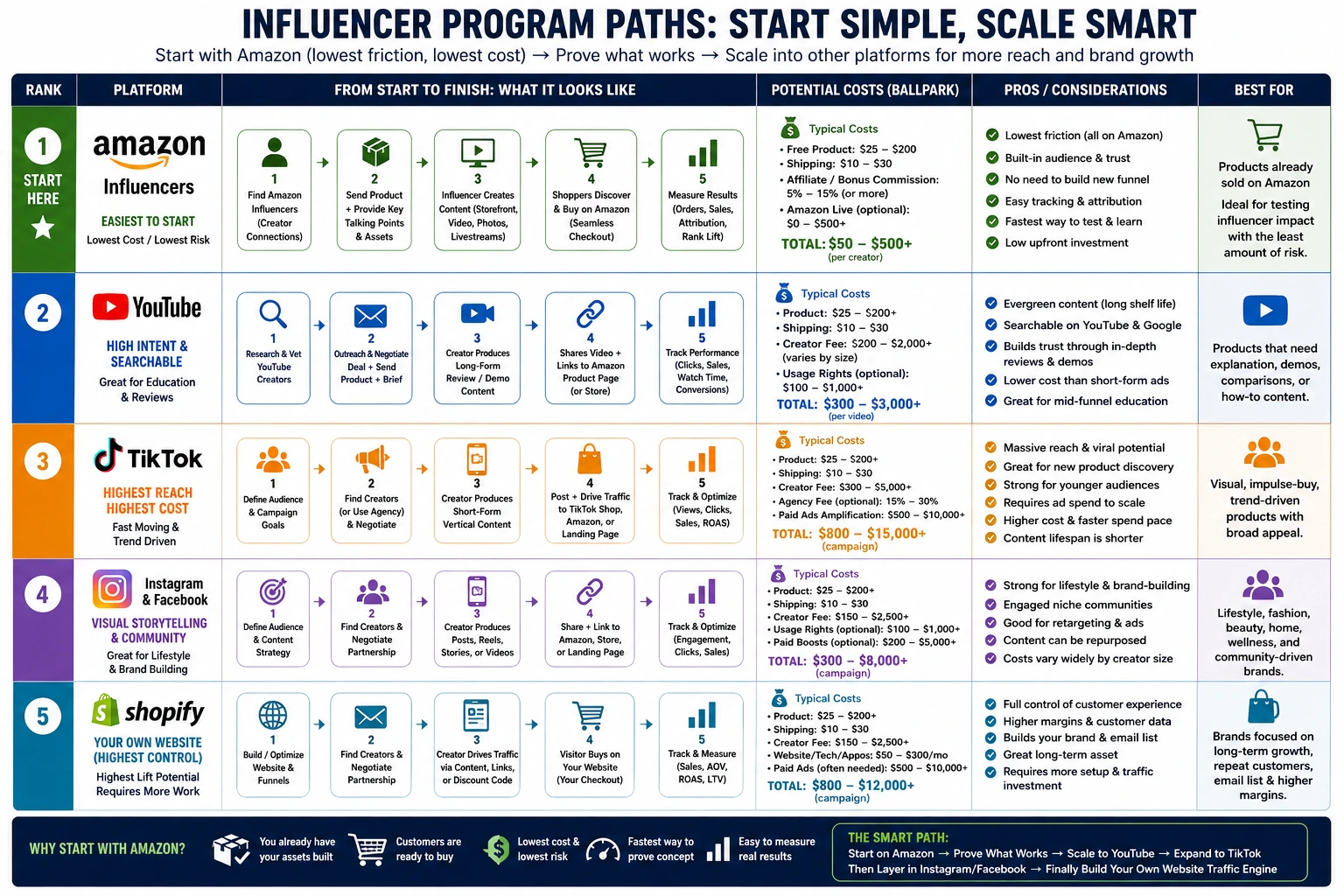
The Best Influencer Strategy Is Sequential
The strongest influencer strategy is usually not “do everything everywhere.”
A better sequence is:
Optimize the Amazon listing.
Choose one to three strong test products.
Start with Amazon-based influencer opportunities.
Track traffic, sales, and conversion.
Improve the offer and listing based on results.
Expand to TikTok, YouTube, Instagram, and Facebook.
Use Amazon Attribution, coupon codes, and reporting to measure performance.
Scale only where the numbers make sense.
This allows sellers to reduce risk and make better decisions.
Final Thoughts
Influencer marketing can absolutely help Amazon sellers grow, but it should be approached with discipline.
The goal is not to chase creators, views, or vanity metrics. The goal is to determine whether influencer-driven content can create profitable demand for your product.
For many sellers, Amazon is the best place to start because the listing, checkout process, customer trust, fulfillment, and product assets are already in place. That makes it a practical environment to test the concept before spending heavily on broader social media campaigns.
Once the data proves that influencer content works, sellers can expand into TikTok, YouTube, Instagram, Facebook, Shopify, and other channels with more confidence.
Start small. Measure carefully. Improve the offer. Then scale what works.